United States / Switzerland / November 24, 2026
A Place in the Factory Queue Is Now a Product
Amylyx and PolyPeptide show what a buyer purchases before the first commercial shipment—and why paid readiness is only part of a deliverable promise.
In This Analysis
- Three primary sources behind the headline
- 1. One agreement can contain several purchases
- 2. A forecast becomes an action when revision rights change
- 3. Less inventory can conceal another commitment
- 4. Which risks does a reservation actually remove?
- 5. What is a lower capacity risk worth?
- 6. Two suppliers do not necessarily create two ready alternatives
- 7. The manufacturer takes a risk too
- 8. The boundary of the conclusion
A supplier can agree to manufacture a product without solving its buyer's problem. Between that agreement and a usable shipment sit a production window, timing, quality acceptance, and permission to sell the output. Until the necessary conditions come together, an attractive unit price does not create a promise the buyer can deliver to its own customer.
This week's case makes that gap visible through disclosed commitments. Our subject is the economics of access to future production. Commercial launch results are not available; this article does not evaluate the medicine's efficacy.
Three primary sources behind the headline
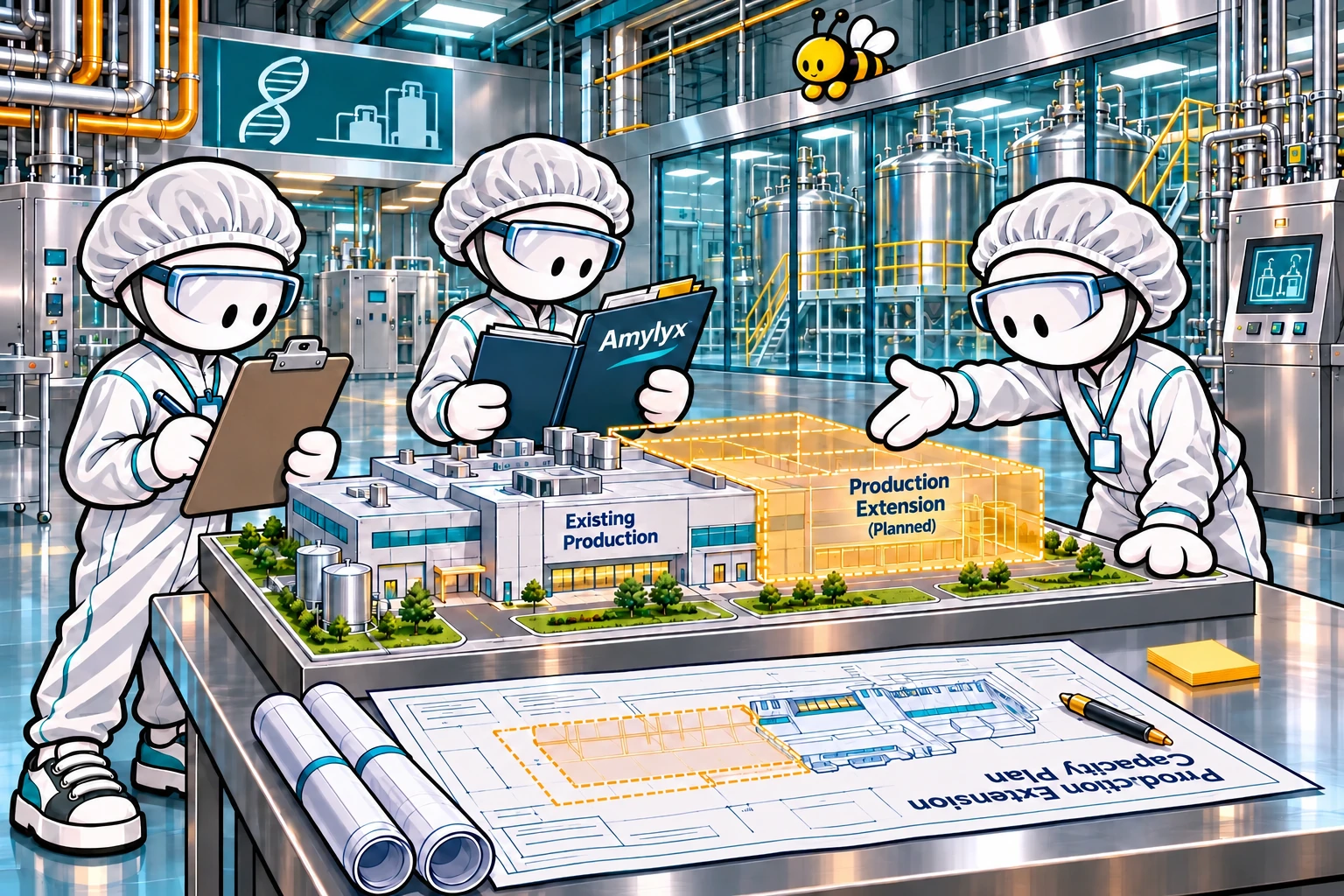
This week's disclosure: November 24, 2026. Amylyx's Form 8-K, Item 1.01 describes a PolyPeptide agreement covering avexitide drug substance for commercial supply if approved. It includes nonrefundable, noncancelable capacity reservation prepayments, annual minimum purchases beginning in 2028, and a portion of forecasts binding on both parties. The previously disclosed $30 million was paid in November. The initial term is eight years; the supplier is nonexclusive. Amylyx says it will file the agreement with its annual Form 10-K.
Background, not a second new announcement. A September filing described the September 8 Bachem agreement and September 1 PolyPeptide term sheet. The $30 million reservation, future minimums, and binding forecast component were already outlined. November's development is the definitive agreement and payment confirmation, not the first appearance of that advance.
The manufacturer's perspective: analytical background. PolyPeptide's first-half 2026 business review reports capital expenditure of €41.3 million and connects major capacity expansion to long-term customer commitments, including prefinancing. That describes its broader business model. It does not establish that Amylyx's money funds a particular factory or expansion.
The documents reveal a purchase of future availability. They do not reveal quantities, the complete price, or every consequence of changing course. Everything that follows is our analysis, not a reconstruction of undisclosed contract terms.
1. One agreement can contain several purchases
A conventional purchasing record identifies an item, quantity, and price. Capacity reservation adds two other dimensions: how long the supplier must remain ready, and which decisions the buyer must make before it receives any output.
| What is being evaluated | The question it answers | What it does not establish |
|---|---|---|
| Physical batch price | What does manufactured, accepted product cost? | That the price includes all production access costs |
| Readiness cost | What is purchased before manufacturing begins? | That the reservation will be used or refunded |
| Buyer commitment | Which demand decisions can no longer be freely revised? | That a working forecast remains optional |
This is a reading framework, not a description of the agreement's accounting. One payment may serve several functions, and important terms may remain confidential.
The purchasing implication is to compare equivalent service rights before comparing unit prices. A low quote without a confirmed delivery window and a higher quote with committed availability are different offers. A single price column hides that difference and pushes its consequences into somebody else's operating plan.
There is a useful counterexample. Where spare capacity is readily available and the process is portable, reservation can be an unnecessary expense. The existence of a reservation payment does not prove that paying it was economically necessary.
2. A forecast becomes an action when revision rights change
A sales forecast estimates future demand. A supplier may also use it to purchase materials, change its schedule, or accept other customers' orders. An agreement can make part of that forecast binding. Improving the estimate and obtaining permission to revise the purchase commitment are then different tasks.
Hypothetical example, not Amylyx terms: a plan contains 100 units, of which 40 are binding and 60 are informational. The demand estimate falls to 70. Two revisions with the same total have different consequences:
| Plan version | Binding quantity | Informational quantity | Total |
|---|---|---|---|
| Original | 40 | 60 | 100 |
| Reduce only the flexible portion | 40 | 30 | 70 |
| Also reduce committed volume | 20 | 50 | 70 |
The second row preserves the binding 40 units. The third attempts to remove 20 of them. Both reduce total demand by 30, but the total alone conceals which undertaking changed. Whether that revision is permitted, and what it costs, depends on the agreement. Amylyx's binding horizons and revision rules are not publicly disclosed.
The commercial team therefore needs more than the latest accurate forecast. It needs a history of the binding portion: the original version, quantities accepted by the counterparty, and agreed changes. A better estimate must not silently become a new manufacturing instruction. Otherwise the internal spreadsheet improves while the earlier commitment remains.
One testable hypothesis is that consistently separating these portions reduces forecast disputes. Evidence would be the number and cost of unauthorized changes. Better forecast accuracy alone would not establish the effect: demand, product, or production may have changed at the same time.
3. Less inventory can conceal another commitment
There may be no finished stock even though cash or future purchasing volume is already committed. We propose a management register of commitments that cannot freely be reversed: nonrefundable payments, noncancelable orders, minimum purchases, and exit costs. This is not a new accounting category. It shows which future choices earlier decisions have constrained.
The amounts cannot simply be added. If an advance is credited against a purchase, adding it to the full price of the same goods overstates the burden. Potential loss also differs: product suitable for another customer may recover value, while highly specific output may find no other use. The public Amylyx summary cannot establish these effects.
A comparison needs two separate quantities: cash released from physical stock and new obligations taken on instead. Our book analysis distinguishes cash release from recurring savings in more detail. Here the next question is contractual: what happens to an early payment when the buyer's plans change?
4. Which risks does a reservation actually remove?
Amylyx's disclosure puts two different conditions side by side: commercial supply depends on approval, while reservation prepayments are nonrefundable and noncancelable. An early payment may protect access to manufacturing time. It does not itself remove the possibility that commercial demand arrives later or at a lower volume than expected.
| What changes | The resulting question | Missing from the public summary |
|---|---|---|
| Commercial use is delayed | Can prepaid availability move to another period? | Rescheduling rights and costs |
| Demand falls below the forecast | How much purchasing volume remains binding? | The binding horizon and revision rules |
| The supplier fails to provide promised capacity | How does the buyer obtain performance or a remedy? | Remedies and liability limits |
These are questions about possible events, not a description of how the agreement handles them. In particular, nonrefundability does not reveal every buyer remedy for supplier breach. It cannot be read as complete protection for the manufacturer against every consequence.
Capacity may need to be reserved long before other decisions, precisely because other customers could take it. The price should still be compared with a specific reduction in supply risk, separately from uncertainty about demand and commercial launch. The Green Volt analysis examines how manufacturing and site windows fit together. For the calculation here, the key condition is whether the buyer will use the availability it has purchased.
5. What is a lower capacity risk worth?
Every number below is hypothetical. None describes Amylyx, PolyPeptide, or their market. This simplified, single-period example excludes tax, discounting, and risk correlations.
Assume a 70% probability that commercial demand materializes. Conditional on that demand, timely capacity is available with 55% probability without a reservation and 85% with one. Assume an 8 million loss if capacity is unavailable, measured as justified lost contribution plus incremental costs, rather than all foregone revenue.
The expected benefit is 0.70 × (0.85 − 0.55) × 8 million = 1.68 million.
Now assume a reservation fee of 0.80 million, financing cost of 0.12 million, and an additional expected loss of 0.50 million from unused commitments. That last amount is already an unconditional expectation; it must not be multiplied by demand probability again. We also assume it does not duplicate the reservation fee.
The difference is 1.68 − 0.80 − 0.12 − 0.50 = 0.26 million. That is a small positive result, highly sensitive to the assumptions.
If the reservation improves availability by only 15 percentage points, the benefit falls to 0.84 million and the result becomes negative 0.58 million. Holding the three cost inputs fixed and retaining the original 30-point improvement, the demand-probability break-even point is 1.42 / (0.30 × 8), or approximately 59.2%.
The driver is additional executable availability. A reassuring word in an announcement is not an input. Actual probabilities and losses require evidence that the disclosed agreement does not supply.
6. Two suppliers do not necessarily create two ready alternatives
The September disclosure names Bachem; November's names PolyPeptide. The public record contains two manufacturing relationships, rather than merely an intention to find a second source. Nonexclusivity preserves the possibility of using others. It does not establish which batch can move, or how quickly.
That depends on qualifications, materials, process rights, and the second manufacturer's available time. Our proposed measure is the share of an order that can actually move within a specified period, with supporting evidence. This is not a measured company result. The book analysis examines the mechanics of an operational backup in more detail.
A second source can also be valuable without rapid switching, for example as a long-term negotiating alternative. Its value should then be assessed in that role. Treating future choice as a ready emergency substitute understates the risk to the next shipment.
7. The manufacturer takes a risk too
The factory also plans capital, equipment, and people. A promise of future availability constrains its ability to serve someone else.
In principle, firmer customer forecasts stabilize that plan and advances can support financing. Neither mechanism proves that capacity is available or that a particular payment funded an expansion. PolyPeptide's general strategy supplies context, not an execution map for this agreement.
Our negotiating implication is to discuss the observability of reciprocal readiness alongside the payment. How will the buyer know an agreed stage has been reached? Which evidence is sufficient? How does a deviation become visible? Otherwise an early transfer of money and a late shipment confirmation leave a long interval of weak visibility.
The unpublished documents may already address those questions. Their absence from the public summary is an evidence gap, not proof of a poor contract.
8. The boundary of the conclusion
These disclosures cannot establish the actual return on reservation, prove a product-specific shortage, or predict commercial success. They do not support a universal rule that exporters must prepay, or that pharmaceutical procedures transfer directly to food and standard components.
They do support a sharper question about the commercial model: which future company action becomes possible only because access to a resource was purchased earlier? The answer may be machine time, a suitable port area, or a confirmed batch. Each requires its own examination of commitments and alternatives.
A dashboard can reveal a future problem. A resource, the right to act, and enough time to use that right determine whether the business can respond.
Still unknown: the full agreement; advance crediting; quantities and binding forecast horizons; change and exit terms; and the actual readiness of alternative manufacturers. Standard terms from unrelated transactions cannot fill those gaps.
Sources checked November 27, 2026. November's filing is the weekly development; September's disclosures and the manufacturer's half-year review are background. We conducted no interviews or verification of contract performance.
Sources and Verification Limits
- Amylyx — Form 8-K, November 24, 2026, Item 1.01
- Amylyx — September 2026 Form 8-K; background
- PolyPeptide — Half-Year Report 2026, Business Review; background
Checked November 27, 2026. Earlier documents provide background. Hypothetical calculations and editorial models are not disclosed deal terms or test results.