Turkey / Spain / November 27, 2026
A Full Range Is Not Yet a Complete Channel
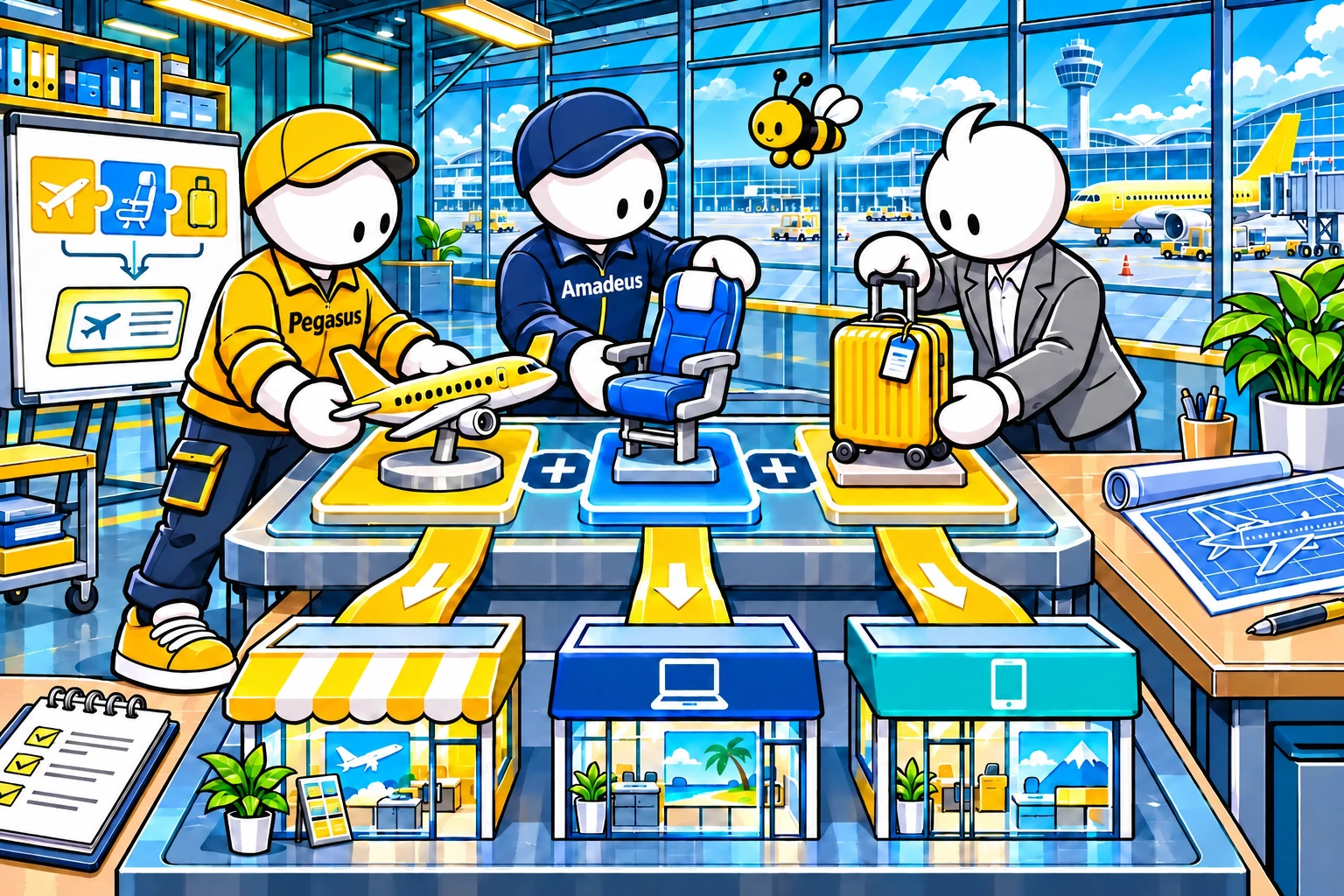
Pegasus and Amadeus: access to an offer, the authority to change an order, and responsibility to the customer are separate questions.
In This Analysis
A partner channel needs more than the ability to display a product. The intermediary has to sell the right combination of options and honor the promise when the customer changes course. An agreement to distribute the full range is therefore the start of a conversation about how a channel works, rather than its final answer.
What was announced
On November 27, Amadeus announced a multiyear agreement with Pegasus Airlines. Amadeus says all content Pegasus makes available through direct connect will also be distributed through its channel, including NDC offers and ancillary services. The release includes comments from both parties. A launch date, commissions, resulting sales, and a complete list of supported operations are not disclosed.
Range, price, and service are different promises
Our conclusion is deliberately narrow: the completeness of the offer is becoming a separate subject of agreement between a service provider and an intermediary. Content availability does not establish equal final prices, identical rules for changes, or the seller’s cost of serving a customer. Those are separate channel characteristics. Evidence for one cannot establish the others.
Consider a hypothetical business traveler. The customer does not need abstract access to a flight. They need a suitable itinerary with options, documents, and the ability to change plans. If the agency can see an offer but must use another interface to perform one action, the product is technically available. Operationally, the sale is already divided across processes. This is an illustration, not a test of Pegasus or Amadeus.
A gap can appear late. When the customer changes nothing, a channel looks convenient. The first exception reveals where the order lives, who can alter it, and who must explain the problem to the buyer. Judging distribution solely by the number of available offers is rather like judging a warehouse by its item count without checking whether it can ship them.
Describe a channel with verbs
Our proposed comparison is a sequence of actions on a single order, rather than a list of connected suppliers. It can also be used outside air travel, for an industrial equipment dealer or a wholesale marketplace, for example. The implementation will differ in each business.
| Action | Commercial question | Possible gap |
|---|---|---|
| Find and compare | Can the intermediary see suitable options? | Only part of the range is available |
| Buy and add options | Can it assemble the purchase the customer needs? | Extras require a separate process |
| Change and cancel | Who is authorized to act after the sale? | The customer has to switch service contacts |
| Resolve an exception | Who owns the resolution? | Responsibility moves between participants |
The table is not an account of tested Amadeus functions. It explains why “access” needs a verb attached to it. Search, purchase, and service can have different limits even when the same companies are involved throughout.
The intermediary inherits a promise
An intermediary often earns the sale through trust. The customer wants to deal with a familiar person or system instead of learning how every supplier works. That advantage creates an obligation to remain a clear point of contact when something goes wrong. If the intermediary receives the request but another party retains the authority to change the order, coordination becomes an additional job.
This is where range meets the intermediary’s economics. More options may attract more buyers. They may also create more exceptions, training needs, and manual work. We do not know whether that will happen under this agreement. Testing it requires actual service requests and handling times alongside sales data.
Nor should every cost be compressed into a commission rate. One connection might have a low visible fee and a difficult correction process. Another might have a higher explicit cost but require fewer manual handoffs. A fair comparison needs the same order scenarios, including a failed one. Otherwise the simplicity of a routine purchase will conceal the cost of unusual events.
For a buyer, predictability may matter more than uniformity. Different channels can legitimately serve different needs. The expensive outcome is discovering the difference only after a purchase, when the person who accepted the order cannot perform the action the customer reasonably expects.
The direct route can still be the right one
A full range through an intermediary is not necessarily the best arrangement for every customer. A buyer who repeatedly purchases one straightforward service and handles changes independently may find a direct process sufficient. Another buyer may value one place to purchase and service products from several suppliers. These are different jobs, not a universal contest between technologies.
The same distinction matters to the supplier. Increasing reach does not necessarily mean handing the entire customer relationship to a partner. Who shapes the offer, who receives demand information, and who resolves a problem after purchase are separate questions. The release does not establish their complete allocation.
Evidence that the channel works
The next useful evidence would be confirmed availability of specific operations and an order followed from selection through a change or completed service. Both a routine purchase and an exception would be informative. We have not independently tested the integration.
The promise in this announcement is to reduce the difference between what the supplier offers directly and what a partner can offer. Whether it also reduces the gap between making a sale and helping the customer afterward remains a separate question. That is where distribution becomes an operating process rather than a storefront.
Sources and Verification Limits
Checked November 27, 2026. Earlier documents provide background. Hypothetical calculations and editorial models are not disclosed deal terms or test results.