A business purchase rarely ends at the buy button. A specification needs an approved budget; an order needs agreed terms; an invoice needs a reason to be paid. Each handoff can lose the context that made the previous decision valid.
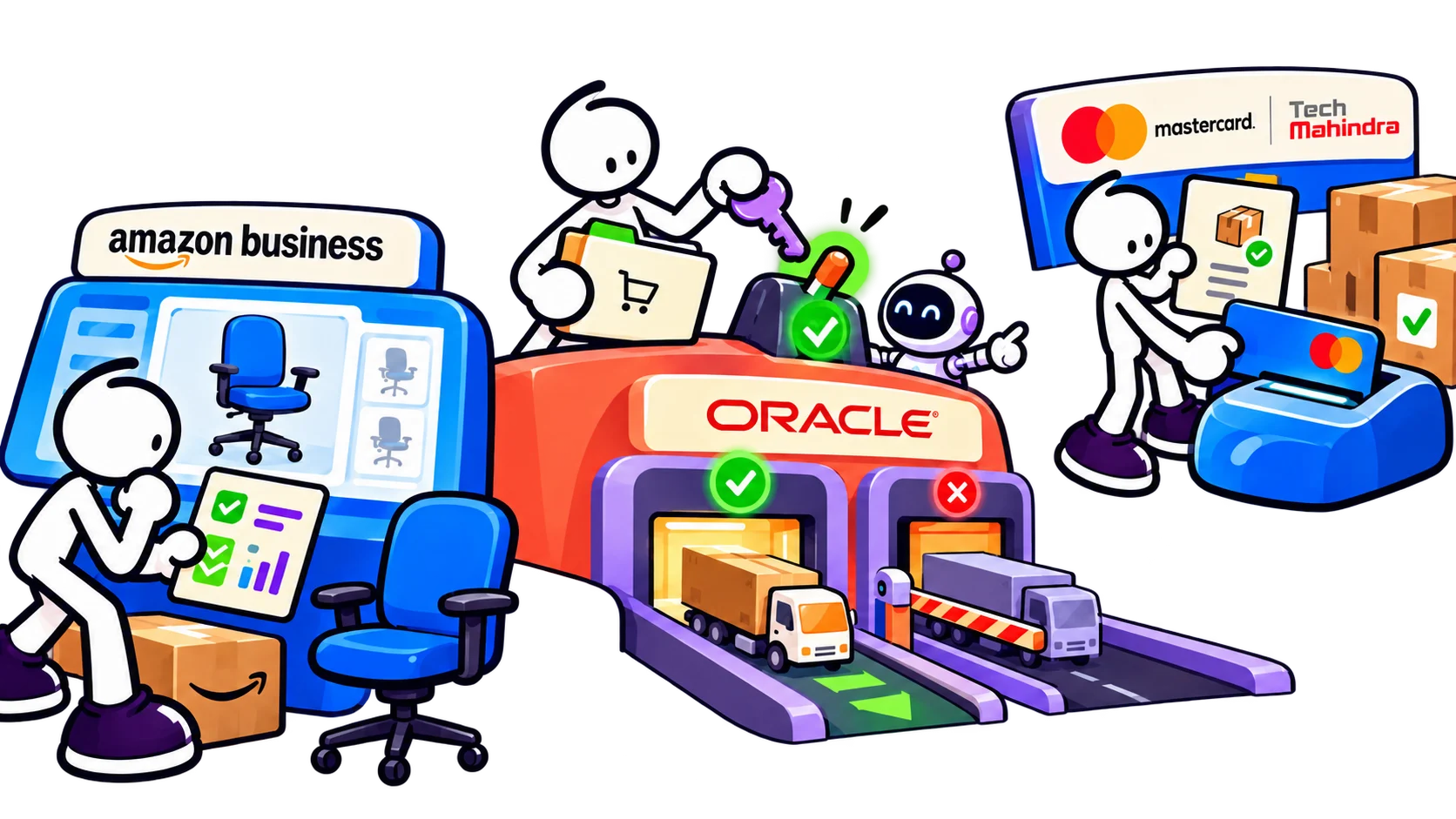
Three separate announcements this week address different pieces of that problem. Amazon Business is bringing purchasing context into partner systems. Tech Mahindra and Mastercard plan to embed payment capabilities into enterprise workflows. Oracle describes applications that prepare or execute supply-chain actions within defined approval boundaries. These are separate initiatives, not a combined alliance.
A useful B2B system carries the state of a deal from one step to the next. Its authority to act must be as clear as the data it receives.
The context belongs beside the choice.
Amazon Business’s October 27 announcement describes procurement integrations with partners including Procurify and Lio. The context includes purchasing policies, budgets, order history and product-search information. The features described are for U.S. Amazon Business customers. Amazon also says it is working with partners including SAP on a proposed B2B domain for the Universal Commerce Protocol. This is work toward a shared model, not evidence of a universally adopted standard. 1
Our practical reading starts with a supplier’s commercial data. The same item can be acceptable for one team and unsuitable for another. A useful offer must preserve units, pack sizes, minimum quantities, lead times, substitutions and the price that actually applies to the account. A polished description cannot resolve an ambiguous unit of sale.
For the buyer, context also means knowing why an option is eligible. If a recommendation ignores a policy or an existing agreement, someone must reconstruct that check later. Moving the interface is valuable only if the relevant rules move with it.
Payment needs the state of the deal.
Tech Mahindra and Mastercard’s October 26 partnership targets virtual-card and payment capabilities inside ERP and procurement environments. The release describes API integration, automation, reconciliation and controls. Working-capital and efficiency improvements are expected benefits; named implementations and measured results are not disclosed. 2
An approved order is not always a payable invoice. A shipment may be partial, a price may differ or acceptance may remain open. Accelerating the transfer of money without resolving those events can make the wrong step faster.
Finance and procurement therefore need explicit definitions: what counts as received, who resolves a discrepancy and which event authorizes payment? In a pilot, these definitions deserve as much attention as the payment interface.
An agent needs a defined authority.
Oracle’s October 26 announcement describes applications within Fusion Cloud Supply Chain Management. Allocation scenarios go to teams for review and approval; procurement-spend corrections are recommended for review; shipment actions operate against authorized execution plans. The announcement does not establish unrestricted autonomous purchasing or a measured customer return. 3
The word “agentic” is an incomplete operating specification. Reading data, preparing a proposed change and executing a permitted action are different modes. A company should know which one it is buying for each use case.
Define what the system may read, what it may change, which limit stops it and who receives an exception. Keep a decision record: the input, rule, proposed action and approval. Speed is easier to trust when an error can be reconstructed.
Context explains the next step.
Authority determines who may take it.
The connected process has costs of its own.
Our analysis is that fewer handoffs may reduce re-entry and waiting, but this must be measured in a specific process. Removing a screen does not remove a three-day approval queue. An integrated process may also become harder to move when its rules, documents and history are tied to one platform.
For a supplier, the question is how to remain easy to buy from across the customer’s systems. For a buyer, it is whether the record can be exported and the process can continue when an integration fails. Those concerns belong in the pilot rather than being left until renewal.
Routine replenishment and a substitute for a critical component also need different handling. A successful standard order is not evidence that the system can manage a quality dispute or an unexpected specification change.
Tool Watch: a procurement-spend pilot.
Oracle Procurement Spend · Not tested by B(ornot)2B
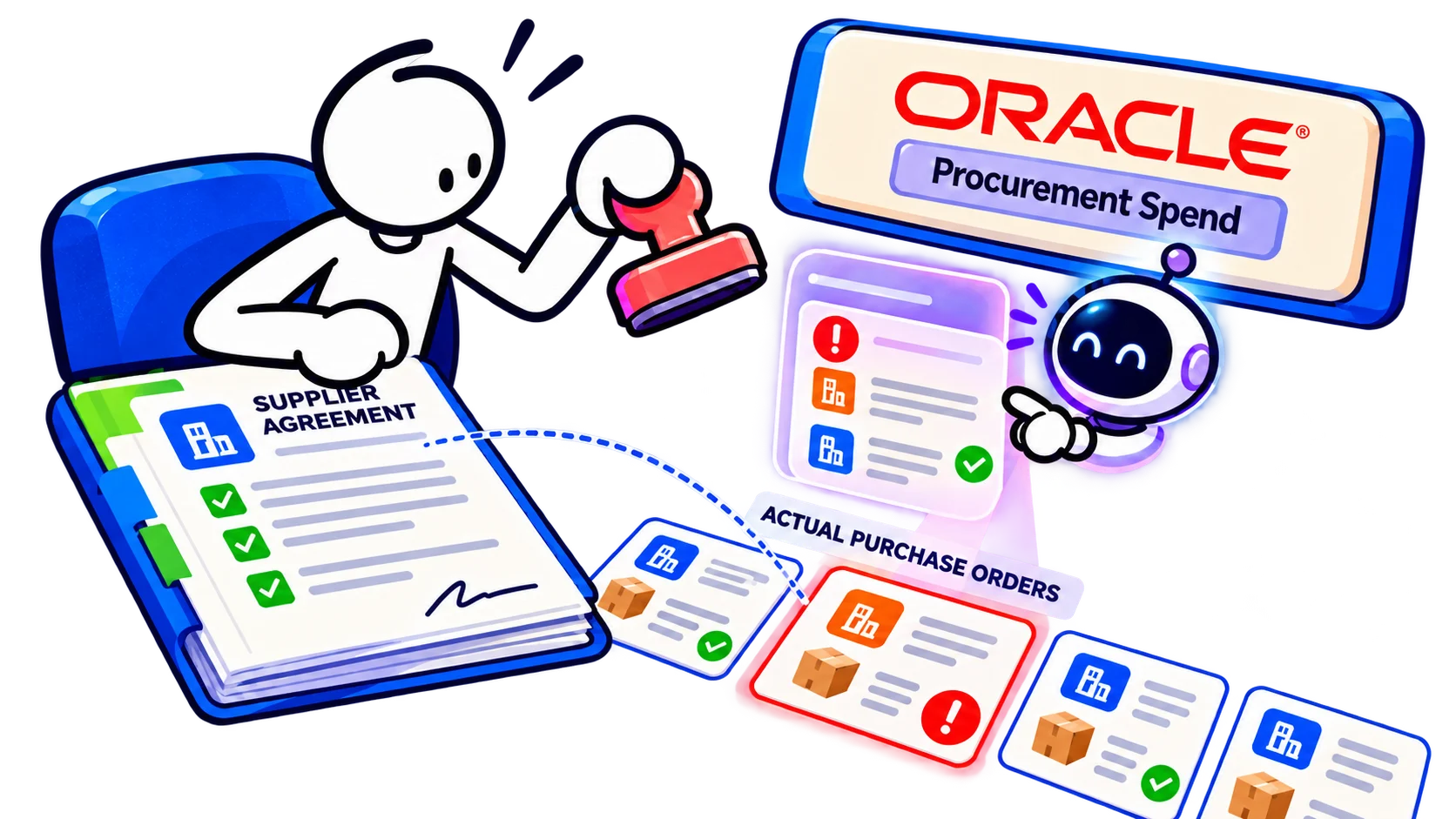
The announced application looks for off-policy purchases and leakage from contracted terms, explains findings and recommends corrective action for team review. Oracle describes availability within Fusion Cloud SCM; customer access, entitlement and implementation requirements need checking.
- Use a real, bounded set of purchase orders and supplier agreements.
- Check whether the explanation identifies the right contractual condition.
- Record false positives, missing data and manual correction time.
- Test permissions and the route from recommendation to approval.
- Compare the process with its starting point before claiming savings.
This is our suggested evaluation approach, not a product test or a promise of performance.
Start with one handoff.
Choose a repeated transition: request to approval, order to receipt or invoice to reconciliation. Establish a baseline for elapsed time, returns for correction, manual touches and exception handling. Then check whether a change improves that process without losing control or the ability to explain a decision.
The operating question behind these announcements is simple: does the next step know enough to be useful, and does it have permission to act?
Sources and method
A comparative analysis of three original announcements dated October 26–27, 2026. They cover different products and relationships. No tools were tested and no savings were independently measured. The pilot questions and cross-source interpretation are ours.