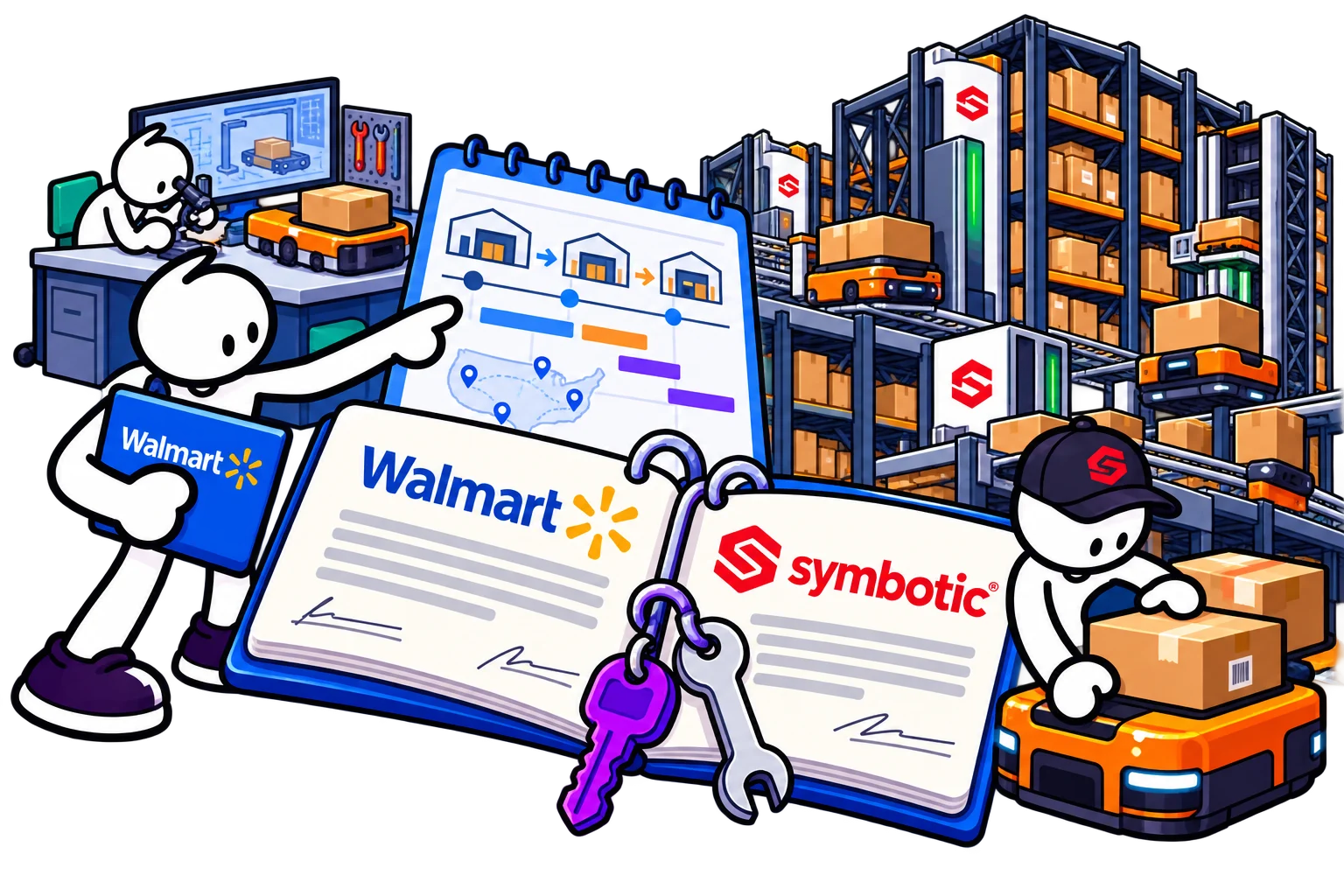
The robots make the picture. The agreement makes the project possible. Walmart and Symbotic’s latest expansion offers a useful view of what an industrial buyer purchases alongside a piece of automation: development, continuing support and an allocation of risk over several years.
On October 29, the companies announced additional automation across 25 U.S. regional distribution centers. Symbotic described an initial additional spending commitment of approximately US$6 billion over several years and multiple locations. Its Form 8-K provides the commercial detail behind that headline. 1, 2
Read the commitment correctly
One headline. Several obligations.
| Disclosed | What it means |
|---|---|
| Approximately US$6 billion initially | A multiyear spending commitment, not revenue already earned |
| US$125 million for development | Included in that initial commitment |
| Continuing fees | Licenses, support, operation, maintenance and spare parts sit beyond the initial commitment |
| Redacted information | No complete site-level payback calculation is possible from the disclosure |
Large-scale automation requires an agreement about the future: what must be created, who pays for it, how readiness is accepted and how the parties respond when the plan changes.
Someone has to fund what does not exist yet.
The filing includes US$125 million for next-generation racking and related capabilities. That is part of the initial commitment, not an extra amount to add to it. 1
For an industrial buyer, the distinction between a product and a development program matters. A familiar product specification may describe something a supplier can already deliver. A development scope describes work whose useful result is still uncertain. Combining the two without a clear boundary makes it harder to know what a payment has secured.
A useful negotiation therefore asks for milestones, evidence and decisions. Which capability must be demonstrated? Who supplies the test conditions? Who decides that a prototype is ready for deployment? These are questions suggested by the commercial structure, not additional terms we claim to have found in the agreement.
The purchase price continues after installation.
Symbotic’s filing lists licenses, system support, operation and maintenance, spare parts and related expenses in addition to the initial commitment. 1
Comparing equipment quotes on purchase price alone can send costs to a different budget rather than remove them. Procurement, operations and finance need a common horizon: implementation, use, upkeep and eventual change. A cheaper installation may carry a different service dependency; a bundled service may transfer useful responsibilities while limiting alternatives.
Performance also needs a shared definition. Equipment availability, recovery time and the throughput of a whole warehouse answer different questions. A functioning machine can still wait for stock or block a downstream process. A pilot should make those distinctions measurable before the business case turns them into a single savings number.
A volume commitment allocates a change of plan.
Item 1.01 says the initial commitment cannot be reduced without mutual written consent, subject to termination rights. It also describes a calculation of amounts due if Walmart buys fewer systems than committed. Details are not fully public. 1
Our interpretation is that the customer’s purchasing plan and the supplier’s resource plan become linked. Engineers, production capacity and implementation teams may need to be arranged before a finished system arrives on site. A change in demand leaves a practical question: who carries the cost of resources already prepared?
The existence of a provision does not tell us the size of a possible payment. Nor does it make every announced dollar unconditional revenue. We do not calculate a hypothetical penalty or treat the program as completed work.
The customer orders equipment.
Both sides make commitments about the future.
A large customer can affect the supplier’s next deal.
The filing also describes restrictions on selling or licensing to a specified company and related parties; that company is not named in the public summary. 1
That raises a wider commercial question. What can the supplier reuse after doing work for one customer: knowledge, software, designs or a way of operating? Restrictions on a market, customer group or use case have value even when they never appear as a separate price line. Without the full terms, we cannot value that constraint here.
Six questions before the payback slide.
- Which operating problem are we measuring: cost, capacity, errors or resilience?
- What exists today, and what still has to be developed?
- Which costs remain after purchase and go-live?
- Who accepts the result, against which evidence?
- How does the program change if demand or technology changes?
- What data, knowledge and options remain with each party when the relationship ends?
These questions travel well to a smaller warehouse project, a manufacturing contract or an integration for one major account. Their usefulness does not depend on the size of the headline.
The deal behind the robots is the agreement that lets technology, resources and responsibilities move together. Its eventual performance still has to be demonstrated in operation.
Sources and method
Based on the October 29, 2026 announcement and Symbotic’s Form 8-K, particularly Item 1.01 and the filed agreement. Some information is redacted. The commercial interpretations and questions are ours; we have not evaluated implementation or calculated a return on investment.