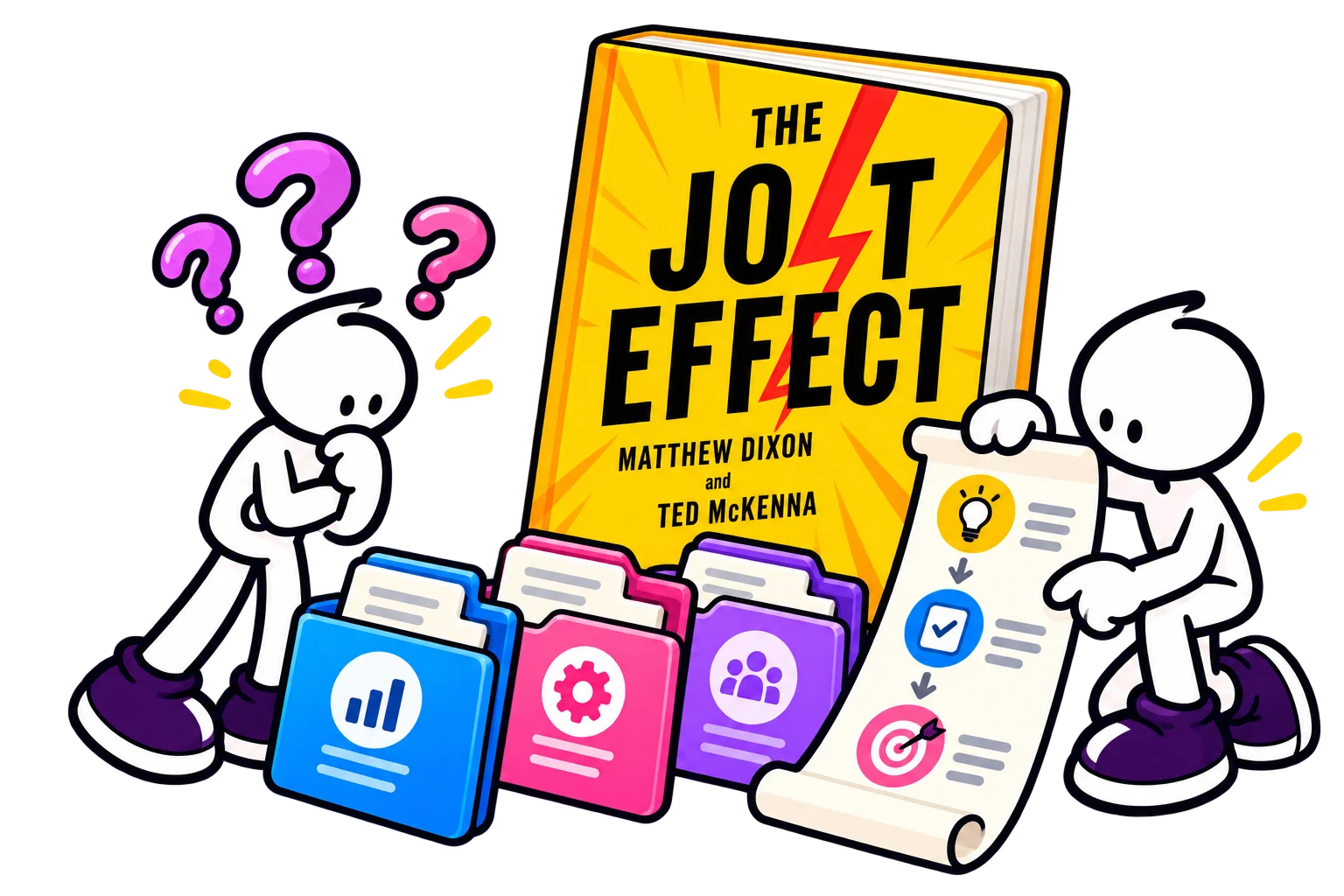
The need is agreed. The proposal fits. Yet the signature moves again. Dixon and McKenna distinguish a buyer who does not want to change from one who wants to change but fears getting it wrong. The response should depend on which obstacle is actually present.
Idea 01 · Introduction; Chapters 1–2
Seeing the value is not the same as deciding.
Dixon and McKenna distinguish a preference for the status quo from indecision after the buyer accepts a reason to change. A customer may want the outcome but fear choosing the wrong option, having too little evidence or failing to realize the promised benefit.
That distinction changes the conversation. More urgency can explain why action matters while leaving the fear of a bad decision untouched.
“Customers, it turns out, are much less worried about missing out than they are about messing up.”
Matthew Dixon and Ted McKenna · The JOLT Effect · Introduction
A packaging-line customer keeps moving the approval date. Ask whether the unresolved issue is configuration, an untested material or commissioning risk. Another savings slide will not replace the material test if that is the missing evidence.
Where the idea needs care. Budget limits, certification, changed priorities and a weak offer are real obstacles. Indecision is a hypothesis to investigate, not a diagnosis of every delayed buyer.
Idea 02 · Chapter 3 · Judge the Indecision
Find out how the buying team will decide.
Budget, authority and product fit do not fully explain how a team will make a choice. The authors suggest looking at whether the buyer can compare alternatives and accept trade-offs. Repeating a question without a new criterion is different from research that closes an identified gap.
The useful record is observable: who decides the next question, what evidence is needed and what changes after the meeting? Another date in the calendar is not necessarily progress.
Alongside the expected order date, record what engineering must approve, what procurement must verify and what the finance director needs. If a meeting changes none of these answers, investigate the obstacle before moving the forecast.
Where the idea needs care. A long tender or mandatory audit does not demonstrate an inability to decide. Analyze the process without labeling the person.
Idea 03 · Chapter 4 · Offer Your Recommendation
After diagnosis, make a recommendation.
Open questions help a seller understand the need. Endless preference gathering can leave the buyer alone with the complexity. In the book, a useful recommendation rests on the needs already established and explains why a particular choice is suitable.
A recommendation becomes more useful when the buyer can inspect its basis, compromise and conditions. It can then be discussed with colleagues rather than accepted solely on the seller’s confidence.
A distributor compares three compressors and recommends B: it provides the required redundancy, A does not and C adds capacity not currently needed. Keep the options visible, but explain the load assumptions that would require the recommendation to change.
Where the idea needs care. Confidence cannot replace engineering evidence. State what remains unknown and preserve the buyer’s ability to choose differently.
Idea 04 · Chapter 5 · Limit the Exploration
Give the next piece of evidence a job.
Another demonstration, reference or comparison should answer an identifiable question. The authors suggest establishing the doubt a new request is meant to resolve. Otherwise the seller can keep supplying information without a criterion for when the evidence will be sufficient.
This depends on real expertise: anticipate questions, organize information and bring in a specialist when needed. Pretending to know is a poor basis for helping someone stop researching.
Before repeating a logistics pilot, agree its question, data and acceptance criterion. If the concern is overnight support, another dashboard demonstration may contribute little. The relevant evidence is an escalation procedure, responsible staff and a test of that situation.
Where the idea needs care. Do not use this idea to avoid an inconvenient security review, quality test or audit. Reduce redundant work while preserving necessary checks.
Idea 05 · Chapters 6 and 10 · Take Risk Off the Table
Make the bad scenario manageable.
The authors discuss realistic expectations, smaller starting commitments and arrangements that limit the consequences of failure. A complex purchase may need stages, support or a bounded right to reconsider. A large upside does not explain what happens if implementation goes wrong.
One anonymous story separates a difficult unit into a one-year agreement with an exit option while the wider deployment remains on a five-year term. The participant says this helped the deal proceed. Names, prices and later profitability are not disclosed.
Separate a warehouse-automation project into testing, a first phase and expansion. For each, define readiness, the parties’ duties and what happens if the criterion is missed. Turn a discussion about reassurance into a launch plan that can be checked.
Where the idea needs care. An exit clause will not fit every deal’s economics. Do not promise zero risk or a result dependent on actions outside your control.
Idea 06 · Chapter 7 · Becoming a Buyer’s Agent
Show where your advice stops.
The customer knows the seller benefits from a sale. The book’s “buyer’s agent” describes a way of earning trust: avoid unnecessary scope, acknowledge limits and say when more checking is needed. It is a behavioral analogy, not a claim about a legal agency relationship.
In one anonymous software conversation, a seller recommends beginning with five seats instead of ten to establish an initial user group. That illustrates a smaller start; it does not prove that the concession always pays for itself through expansion.
A raw-material supplier identifies which properties are documented, which intended use requires a trial and why a large first order should wait for that trial. The buyer receives a credible sequence instead of a general assurance of suitability.
Where the idea needs care. The seller’s commercial interest remains. Helpful behavior complements the contract, testing and independent assessment when required.
Idea 07 · Chapters 8–9 and 11
Pass the buyer’s doubts to the delivery team.
A signature does not automatically remove anxiety. The book considers worry after a decision and the risk of reopening it. A sale built on realistic expectations should lead into an equally clear start; otherwise implementation receives promises it never helped make.
For adoption, the authors discuss studying the company’s own sales process and developing specific skills through review and coaching. Establish a baseline and track more than closing rate. A shorter sales cycle, fewer cancellations and a better launch are different outcomes.
After signing, a freight forwarder gives operations a short record: what worried the customer, what was promised, what the first shipment must demonstrate and who will call if it fails. Review start delays, cancellations and unexpected work alongside new orders.
Where the idea needs care. This handoff example is ours. Compare changes in results with customer mix, seasonality and offer conditions before attributing them to one selling behavior.
Try it with your team
Revisit one stalled deal.
- Check that the customer actually wants the change; polite agreement is not enough.
- Separate missing evidence from concerns about choice, sufficient research or the outcome.
- Make one recommendation with its basis, trade-off and conditions for revision.
- Propose a next step that reduces a specific risk and has a clear completion criterion.
- Record the expectations and concerns that delivery must receive after signature.
The book and its evidence
Based on the introduction, Chapters 1–11 and the research explanation in Chapter 1. JOLT stands for Judge the Indecision, Offer Your Recommendation, Limit the Exploration and Take Risk Off the Table.
The authors describe analyzing more than 2.5 million recorded sales conversations from dozens of companies. The sample includes simple and complex sales; a conversation count is not a count of unique B2B deals. Tethr transcribed conversations and analyzed associations between conversational features and outcomes supplied by participating companies.
This is observational analysis using a private dataset. The book does not supply the complete data or an independent replication. An association with a result does not show that a single technique will cause the same improvement elsewhere. We do not present its figures as current worldwide sales statistics or a forecast of your results.
The JOLT Effect · Matthew Dixon and Ted McKenna · 2022. Chapter references help locate the ideas across print and digital editions.
Publisher’s book page ↗If the difficulty lies in the joint offer itself, return to how the partners create and share value. Six ideas from The Partnership Economy ↗