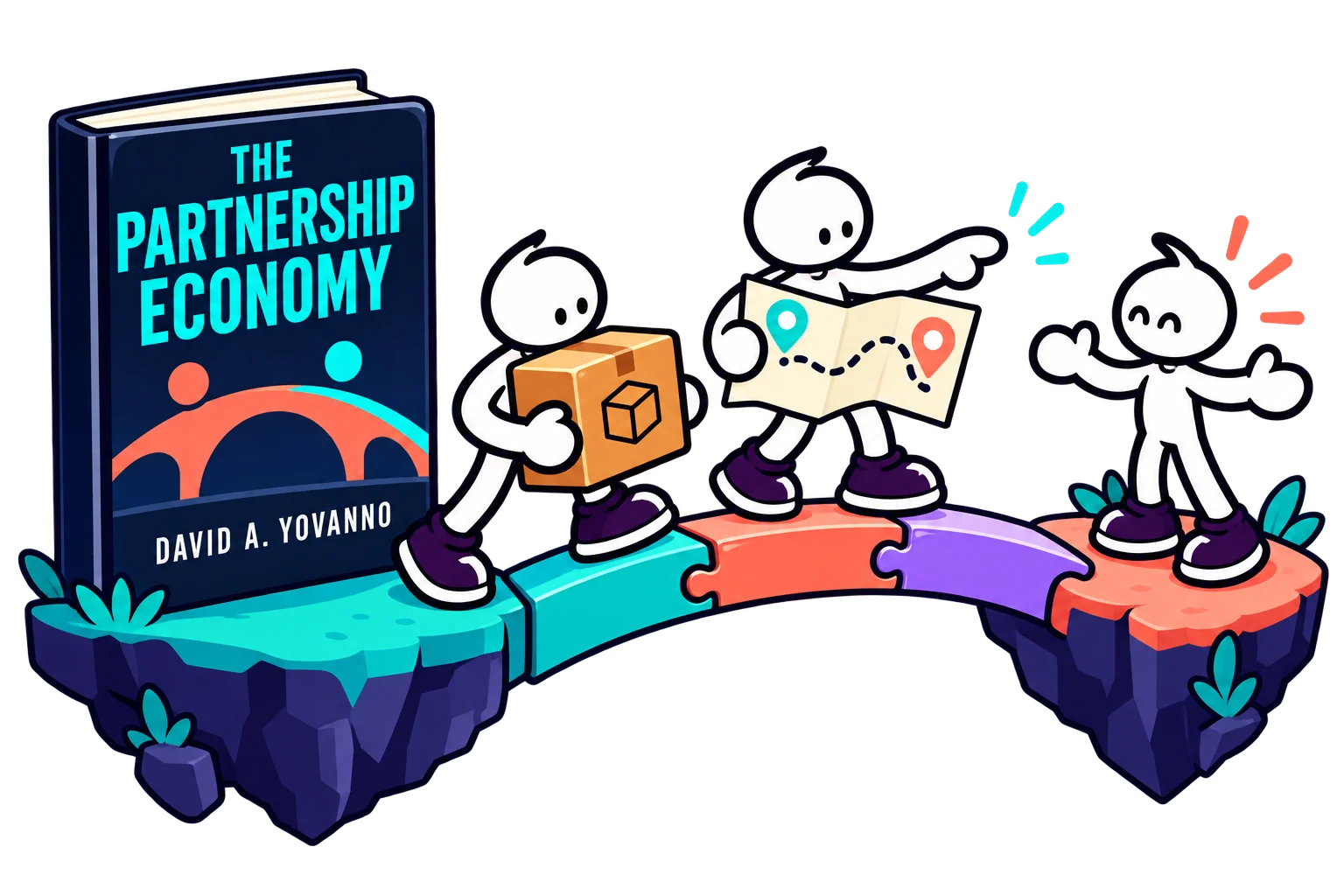
A partner can offer access to an audience. Yovanno asks a more useful question: what becomes better for the customer when the two companies work together, and why will both keep contributing after launch?
Idea 01 · Chapters 3–4
Start with the customer’s unfinished task.
Yovanno connects partner selection to the behavior a business wants to help a customer complete: discover, understand, choose, buy or return. Different partners can influence different moments. The size of an audience does not explain why that audience would need a particular offer.
For B2B, the useful sequence is to identify the obstacle first, then find the organization already present where it occurs. That produces a reason for cooperation that the customer can recognize.
An industrial-packaging supplier finds that customers struggle to match a material to a new machine. A line integrator may be a useful partner: joint material selection and testing help complete a specific commissioning task. Validate that need before negotiating a joint campaign.
Where the idea needs care. The book includes many consumer and referral models. Industrial specifications, trials and procurement rules still apply; access to an audience cannot replace them.
Idea 02 · Chapter 5
Design the exchange before negotiating the reward.
The Partnership Design Canvas brings together six elements: compatible partners, relevant customers, a desirable customer experience, accurate measurement, a motivating value exchange and a shared success plan. The links matter. A promise to pay for a result is incomplete until the parties agree what counts as a result.
The framework is useful as a conversation about contributions, actions and expectations. It brings roles, milestones and responsibilities into view before a vague statement of mutual benefit becomes a signed commitment.
An equipment distributor and a service company put one proposed offer on a page. They identify the buyer, separate equipment from service responsibilities, assign the lead, define evidence of delivery and agree how disputed referrals are handled. This is our adaptation, not a contract template supplied by the book.
Where the idea needs care. A canvas reveals open questions. Technical compatibility, data permissions and enforceable obligations still need their own checks.
Idea 03 · Chapters 5–6
Attribution and additional value are different questions.
In the book’s Harry’s example, a financial partner is called ACME rather than identified by its real name. Compensation follows customer introductions and subsequent purchases. That illustrates a reward linked to observed behavior instead of one large payment based only on estimated lifetime value.
Yovanno also asks whether a sale would have happened without the partner. Tracking a customer’s route can show participation; it does not automatically establish incremental demand. A last click and an additional customer answer different questions.
A consumables supplier and an industry consultant distinguish a new plant introduction, support for a trial and repeat orders. Each contribution needs evidence and a payment rule. Evaluate margin and support costs as well as turnover; investigate how much business is new to the supplier.
Where the idea needs care. The example does not mean every program should pay on repeat purchases. In a long B2B deal, several teams may contribute, and ownership disputes need explicit rules.
Idea 04 · Chapter 10
A joint promotion and a shared product need different commitments.
The strategic-partnership chapter spans activities from promotion to deep product integration. Its Qantas and Airbnb example places accommodation within an airline customer’s journey. The important mechanism is a neighboring need appearing at a useful moment. It is a historical example in a 2022 book, not a verification of the service today.
As integration becomes deeper, the work expands beyond marketing. Product decisions, engineering, data exchange and ongoing support need people with the authority to commit resources.
A machine manufacturer and a diagnostics provider want a shared equipment-status interface. Before launch they define data access, maintenance of the integration, incident response and the promise made to the customer. A successful joint webinar would not establish readiness for this shared service.
Where the idea needs care. A consumer integration is not a reliability specification for industrial equipment. Plan how the relationship can end and how customer data can be moved.
Idea 05 · Chapters 12 and 15
The signature starts a working process.
Yovanno describes a recurring partnership lifecycle: discover and recruit; contract and pay; track; engage; protect and monitor; optimize. An agreement opens the relationship, but does not prove that a partner can consistently bring suitable customers or deliver a useful experience.
Training, materials, reliable accounting and feedback turn a program into daily work. Monitoring also means checking the validity of outcomes and adherence to agreed rules. Software can support that work; it cannot decide what the relationship is for.
Instead of signing twenty more dealers, review ten existing ones. Who completed training? Who supplied a qualified enquiry? Where did the response stall? Why did the first delivery fail to happen? A shared register and named owners may be enough to start learning.
Where the idea needs care. At publication, the author led impact.com, a partnership-management technology provider. The value of a process and the need for a particular platform should be assessed separately.
Idea 06 · Chapter 13; quotation from Chapter 2
Trust is maintained in ordinary operations.
Partner experience is how clear and workable the relationship feels from the other company’s side. In Yovanno’s Walmart discussion, tools, offer data, performance information and internal cooperation support the partner’s work. The broader point is practical: a partner needs relevant information, visible accounting and a way to get help.
A recommendation also puts the partner’s reputation at stake. If the experience breaks after a referral, both parties face a problem. Explanations and reliable follow-through matter when conditions change or an attribution is disputed.
“Partnerships are built on trust and they inspire trust.”
David A. Yovanno · The Partnership Economy · Chapter 2
For an engineering practice recommending your equipment, a current specification, a clear response time and a visible enquiry status may be more useful than another general presentation. Walk through its process: find the document, submit an enquiry, check the fee. Identify where a personal call is still required.
Where the idea needs care. An easy experience still needs controls: valid referrals, lawful data handling and clear payment grounds. Convenience is not a substitute for a reliable record.
Try it with your team
Design one partnership hypothesis.
- Name one customer task and the moment help is needed.
- Specify each party’s contribution: access, expertise, product, delivery or support.
- Choose an observable action that earns a reward; separately decide how to investigate additional value.
- Assign responsibility for handoffs, delivery, data and disputed cases.
- Try the arrangement with a small number of customers before expanding.
The book and its evidence
Based on the full text, with particular attention to Chapters 3–6, 10, 12–13 and 15. This is a practitioner’s account of referral and other modern partnerships; it is not a complete guide to every manufacturing, dealer or procurement relationship.
At publication, Yovanno was CEO of impact.com, a partnership-management technology supplier. The book includes customer stories and research commissioned by impact.com, including Forrester Consulting work. We do not treat those associations as proof that a program will cause growth in any company. Historical services and cases have not been re-tested for this article.
The Partnership Economy · David A. Yovanno · 2022. Chapter references help locate the ideas across print and digital editions.
Publisher’s book page ↗A partner can help create the offer. What if the buyer sees the value but still cannot decide? Continue with seven ideas from The JOLT Effect ↗