The buyer has to sell a decision too
A seller has a product, a proposal and a prospective customer. A procurement professional has an internal customer, a budget, senior management and colleagues who will have to use the outcome. The Procurement Game Plan is particularly useful when it explains this second sale: persuading the organisation to involve procurement earlier, commit people to supplier selection and actually use the agreement afterwards. For a B2B supplier, this helps explain why a persuasive conversation with one interested engineer may not be enough.
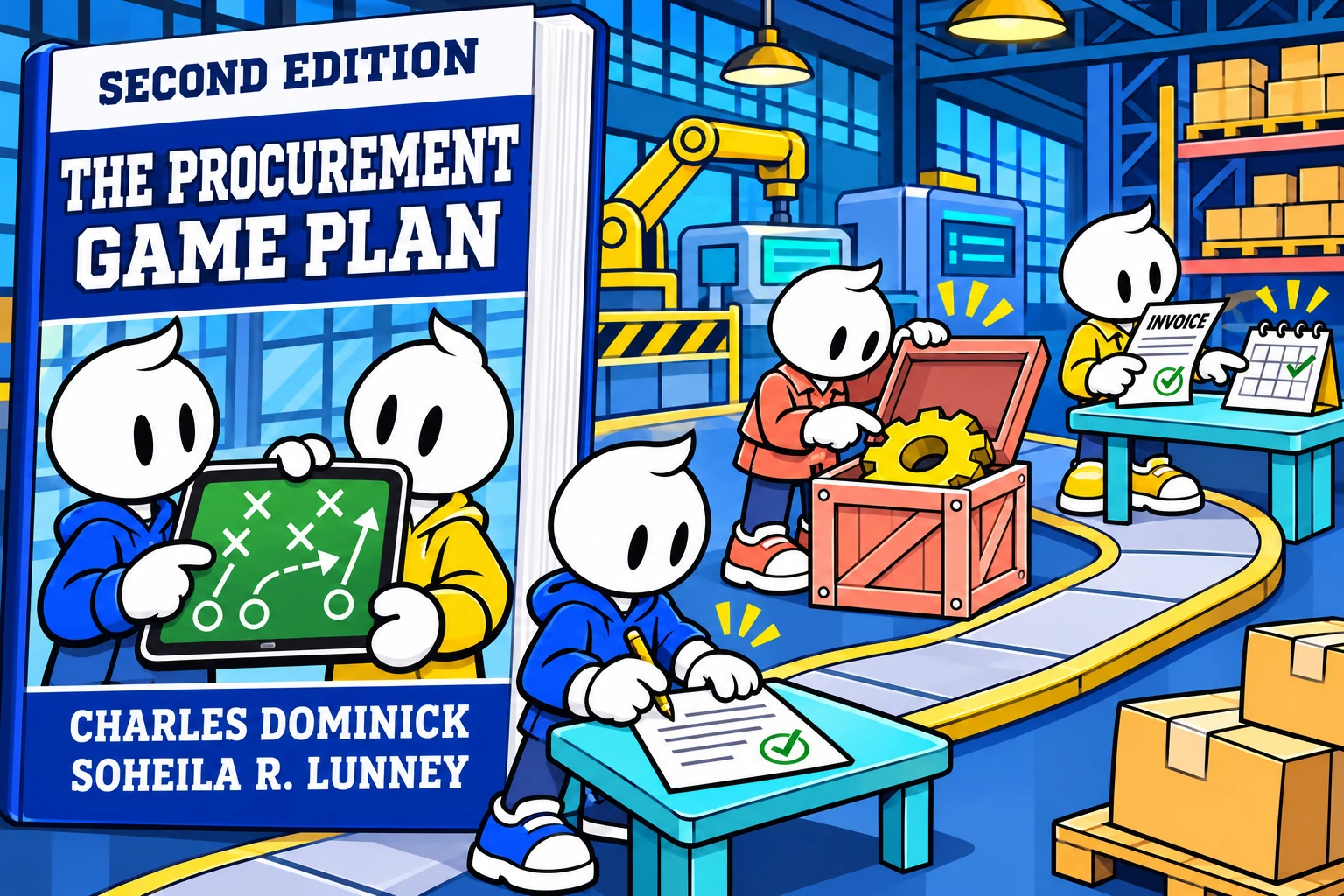
Charles Dominick and Soheila R. Lunney write as experienced procurement practitioners and educators. Their definition of procurement performance extends to quality, supply continuity, cash flow, productivity and the organisation’s commercial objectives. The first chapter already allows that speed to market can matter more than maximising cost reduction. Reading the book simply as a guide to extracting the largest discount would therefore miss its substance. Its central question is how procurement becomes useful and demonstrates that usefulness. [PDF 29–49.]
Our conclusion is that a supplier should understand how the buyer will defend a decision internally, alongside the underlying requirement. A manufacturer might need a production line ready for launch; a distributor might need availability without excessive stock; a service business might need faster recovery from an outage. These are our applications. The authors do not provide a universal sales presentation, and the connection between a proposal and an outcome still needs evidence from the particular customer.
Strategy needs resources and owners
Chapter 2 turns procurement strategy into a document of persuasion. The starting point is an organisation-wide problem or opportunity, followed by the cost of inaction, an operating plan, resources and financial effects over time. SWOT matters when it leads to a choice. Chapter 3 adds the human constraint: roles, skills, training, retention and knowledge transfer. Declaring procurement strategic does not automatically create a team capable of performing the additional work. [PDF 51–104.]
For this magazine, the practical transition is important: when a customer changes supplier, who internally will fund trials, revise specifications, train users and confirm the outcome? We derive these questions from the book; they are not a reproduced questionnaire. A supplier can help assemble the case for a decision, but should not promise benefits that depend on people who have not been assigned or process changes that have not been agreed.
The authors sometimes offer overly confident universal indicators of “modern” procurement. Reporting directly to top management or maintaining an extensive international supplier base does not by itself establish the function’s quality; elsewhere, the book acknowledges that reporting structures depend on context. We treat such lists as prompts for discussion rather than diagnostic scales. The XYZ business-plan example and its percentages in Chapter 2 are fictional illustrations, not research findings. [PDF 34–38, 62.]
Who takes part in selection?
The chapter on back-door selling takes a wary view of salespeople. A supplier may obtain information about competing bids, divide departments or secure a practical commitment before procurement runs the competition. The authors propose contact rules, staff education and management support. Yet some of the listed sales questions—about timing, users and technical needs—are also necessary for preparing an honest proposal. A question alone does not establish manipulation. [PDF 149–158.]
This chapter is best read alongside the account of strategic sourcing. The selection team includes procurement, a technical specialist, finance, a user and an executive sponsor, each with a distinct role. Our reading is that controls should protect sensitive information and procedural fairness while preserving agreed technical communication. A supplier should establish how that communication works and who participates; a buyer should give competitors equal access to material clarifications. [PDF 160–166, 183–188.]
The same logic explains why knowing one person is not a complete route to an order. An internal product champion may value usability, finance may focus on the budget, production may worry about downtime, and procurement may require comparable bids and a defensible procedure. Our analysis: a proposal becomes stronger when these requirements fit into a verifiable implementation plan. Guessing which participant is “really in charge” does not resolve their different obligations.
Qualify the work
In comparing suppliers, the authors examine whether core competence matches the specific requirement and whether capacity is available for an additional customer. A good reputation does not establish that the particular plant, production cell or team can handle the new workload. Total cost of ownership then extends the comparison to acquisition, use, maintenance, logistics, poor quality, delays and residual value. The quoted price is one part of the calculation. [PDF 185–187, 190–200.]
Our application: a more expensive supplier needs a causal connection between its advantage and the buyer’s costs. “More reliable” becomes useful when both parties agree which failure is being prevented, what downtime costs and the period over which the benefit is assessed. Equipment price alone cannot support that calculation; it needs information about the customer’s usage and process. Unknowns should remain ranges rather than disappear inside an exact-looking total.
Chapter 4 adds social responsibility, sustainability and supplier diversity. Its strength is the attempt to connect these objectives with requirements, supplier engagement and performance measurement. Our conclusion is that a policy statement does not show how qualification, verification or order fulfilment changes. US legal references and definitions belong to the book’s context; we do not present them as verified guidance to the law in force in 2026. [PDF 105–148.]
Can the best terms coexist?
For negotiation preparation, the authors propose assembling an “Ultimate Contract” from the strongest individual terms across submitted bids: price, warranty, delivery and payment. Their qualification matters: they explicitly allow priorities and concessions when the complete package cannot be obtained. The weaker inference is that each term’s separate availability establishes the economic feasibility of combining them with one supplier. Fast delivery might rely on expensive inventory, a low price on an advance, and a long warranty on paid service. Those connections are our examples. [PDF 217–218.]
In the same chapter, the authors show how an unchanged total payment can be shifted towards later stages to preserve the supplier’s incentive to perform. This is a substantive buyer-side view of incentives, but payment timing also determines who finances execution. The connection with Seojeon in our cover story is ours; the company is not a case in the book. Reducing an advance can transfer working-capital needs to the supplier, potentially returning as a higher price, a capacity constraint or a greater risk of delay. [PDF 219–222.]
Our next question for a package of concessions is therefore what changes in the other party’s costs, risk and timetable. Exchanges of terms become easier to assess when the cost of acceleration, inventory, warranty and financing is visible. A long list of desirable conditions cannot replace that calculation. This develops the book’s argument editorially; it does not describe undisclosed terms of the companies in this issue.
Realising agreed savings
One of the book’s strongest sections begins after a winner has been selected. An agreement needs implementation: users must know about it, purchases must follow its terms, delivery must be monitored and exceptions addressed. The authors distinguish savings estimated at signature from savings actually realised. They also acknowledge that poor supplier performance may originate in the buyer’s own processes, including forecasting and inventory management. This is an important counterweight to measuring a relationship only through the counterparty’s breaches. [PDF 272–284.]
Our conclusion for a repeat order is that both parties need shared evidence of performance. If the buyer changes volume, supplies information late or fails to prepare the site, comparison with the original price and schedule needs explanation. If the supplier fails to deliver promised capacity or quality, that needs equally specific documentation. A joint review should identify an event, its cause, an action owner and a date for checking progress. That is our proposed practice, not a copied author template.
The book supports early supplier involvement in development, but its buyer-side position becomes particularly visible here. It proposes mandatory cost disclosure, inspection of records and a cost-plus-fixed-fee model. Open costing can support cooperation, yet the text does not establish this model’s superiority for every project. Our analysis: confidentiality boundaries, payment for engineering, responsibility for volume changes and the allocation of improvement benefits need agreement in advance. Otherwise, early cooperation can become an early transfer of risk. [PDF 286–291.]
A backup source has a price
The book acknowledges the cost of maintaining a second source and the possibility that two direct suppliers depend on the same upstream business. This goes beyond simply recommending diversification. The resilience chapter covers disruption scenarios, organisational readiness, stock and alternatives. It does not offer a universally free route to greater reliability. [PDF 197–200, 302–315.]
Our application to an industrial order: a second logo in the supplier register does not establish interchangeability. Compatible specifications, completed qualification, available capacity and a credible switching time are needed. Who pays to maintain that option is a separate commercial question. A supplier needs more than an offer to stand by “just in case”; a buyer needs an economic basis for expecting constant readiness. These are our verification criteria, not measured outcomes of implementing the book.
When a KPI shapes the contract
The performance chapter carefully examines baselines, actual quantities and recognition of savings. It includes Greg Tennyson’s account of his time at VSP Global: taking saved money out of departmental budgets encouraged stakeholders to involve procurement later. Allowing funds to be redirected to other initiatives helped change the incentive. This is an interview reported by the book’s authors, not one conducted by our magazine. It illustrates a mechanism rather than proving a universal effect. [PDF 328–329.]
A nearby recommendation is more questionable. To obtain management recognition of a price reduction in each year, the authors suggest replacing a three-year sequence of $90/$90/$90 with $95/$90/$85. With equal annual quantities, the nominal total is unchanged and the annual reporting pattern becomes more convenient. The authors also allow other agreed accounting approaches. Our criticism concerns this particular adjustment of price to secure recognition of a metric. [PDF 333–335.]
Consider our own illustrative calculation. If one unit is bought each year, paid for at year-end, and the discount rate is 10%, the present value of $90/$90/$90 is approximately $223.82, versus $224.61 for $95/$90/$85. These are our calculations, not figures from the book or an actual transaction’s financing rate. A different distribution of annual quantities could also remove the nominal equality. Changing cash-flow timing does not become economically neutral because three annual prices add to the same amount.
Our editorial conclusion from this episode is that procurement should first agree with finance how multiyear benefits can be recognised honestly. If measurement conventions encourage rewriting the commercial schedule, the company risks paying for the convenience of its KPI. This does not characterise the entire chapter: it also contains useful discussion of net benefits, transparent baselines and explaining why savings differ from total expenditure.
Judgement behind the scores
The authors provide forms, checklists and approaches to evaluating proposals. These can record criteria and make discussion more consistent. Choosing weights, scale boundaries and acceptable deviations remains a management decision. The included scorecard does not itself contain the data or agreed weights for a particular competition. We have not tested the publisher’s external spreadsheets and do not describe them as validated tools.
There is also a verifiable technical boundary. The Dominick price formula reduces a bid’s score in proportion to its premium over the lowest qualified price. With a maximum of 100 points, a lowest price of 100 and another bid of 250, literal application produces −50 points. The surrounding discussion describes a scale with a maximum of 100; the formula has no stated zero floor. A negative score could be an intentional penalty policy, but that policy needs agreement before the competition. The formula is not automatically objective. Our finding comes from checking the printed expression, not testing the publisher’s file. [PDF 207–208, 453–455.]
The technology chapter is useful for its insistence that automation does not repair a poorly designed process. Its discussion of products and capabilities belongs to a 2022 edition, not our comparative assessment of today’s market. The following chapter’s specialised purchasing, inventory calculations and project methods broaden the range of problems, while requiring their assumptions to be checked. The book helps frame the question to solve; it cannot establish an implementation outcome for its reader. [PDF 345–406.]
Putting the book to work
Chapter 15’s practitioner interviews add different professional perspectives; Chapter 16 addresses careers, development and pay. Together they complete a guide for the person and the function, beyond an individual sourcing event. Expert experience, teaching arithmetic and statistical estimates nevertheless provide different kinds of evidence. For example, the reported association between SPSM certification and higher pay does not establish that training caused the difference. The authors have connections with professional education and that certification; their recommendations should be read with that position in mind. [PDF 407–444.]
Our assessment: the book’s strength is the connected process, from internal justification to actual use of an agreement and verification of its benefits. It is useful for a procurement leader building a function and for a supplier trying to understand the other side’s work. Its limits are uneven evidence and occasional moves from practical advice to overly general rules. It is not a comparative study establishing the superiority of the whole system, or a proven programme guaranteeing greater supplier sales.
For B(ornot)2B, the conclusion returns to this issue’s theme: good procurement must survive time, cash requirements and performance by both parties. Price, payment terms, reserve capacity, specification changes and savings recognition belong to the same transaction economics. The book provides a useful language for discussing them. Our contribution is to keep bringing the supplier back into that discussion: can it deliver the promise, who funds the necessary readiness, and what will both parties verify before placing a repeat order?
Map of the complete reading
| Book coverage | Part of the decision | Our application question |
|---|---|---|
| Chapters 1–2 · PDF 29–84 | Procurement’s role and the case for a strategy | Does the objective serve the whole organisation? |
| Chapters 3–4 · PDF 85–148 | People, capabilities and social responsibility | Are people, verifiable requirements and resources available? |
| Chapters 5–6 · PDF 149–189 | Supplier contact and cross-functional sourcing | Who participates and which information can be shared? |
| Chapters 7–8 · PDF 190–254 | Qualification, comparison and negotiation preparation | Can the complete package of terms be delivered? |
| Chapters 9–10 · PDF 255–301 | Special negotiation situations and implementation | Who turns agreement into actual performance? |
| Chapters 11–12 · PDF 302–344 | Supply resilience and performance measurement | What are we paying for, and against which baseline? |
| Chapters 13–14 · PDF 345–406 | Technology, inventory and specialised purchasing | Have the process, inputs and assumptions been checked? |
| Chapters 15–16 · PDF 407–444 | Practitioner perspectives and professional careers | Which claims are experience, statistics or advice? |
| Exhibits A–H · PDF 445–459 | Illustrative conversations, ethics and working forms | What needs adapting before use? |
This analysis uses the supplied 459-page second-edition PDF. All main chapters and Exhibits A–H were read; figures and tables material to the analysis were also examined visually. References such as “PDF 208” mean the page number in that file, not the printed pagination. The publisher lists 384 pages for the hardcover. The index listed in the publisher’s contents was not found in the supplied electronic text.
External Web Added Value files, including spreadsheets, teaching materials and other publisher downloads, were not obtained or tested. Book examples were not independently replicated through new interviews or access to company records. Historical references, legal provisions and technology discussions are not assumed to be current in November 2026. Edition details and bibliography were checked against the publisher listing on 21 November 2026.